Dental Implants in Essen-Rüttenscheid: Planning, Procedure and Options
Dental implants at the practice in Essen-Rüttenscheid: requirements, procedure, 3D planning, guided surgery, risks, alternatives and costs explained clearly.
Short answer
Dental implants at the practice in Essen-Rüttenscheid: requirements, procedure, 3D planning, guided surgery, risks, alternatives and costs explained clearly.
A dental implant is an artificial tooth root inserted into the jawbone that can later support a dental restoration. Implants can replace a single missing tooth, restore larger gaps or serve as anchors for more extensive prosthetic treatment.
Whether an implant is appropriate depends on more than the gap itself. Relevant factors include oral health, available bone, neighbouring anatomical structures, general medical conditions, medication, smoking, and whether the finished restoration can be kept reliably clean over the long term.
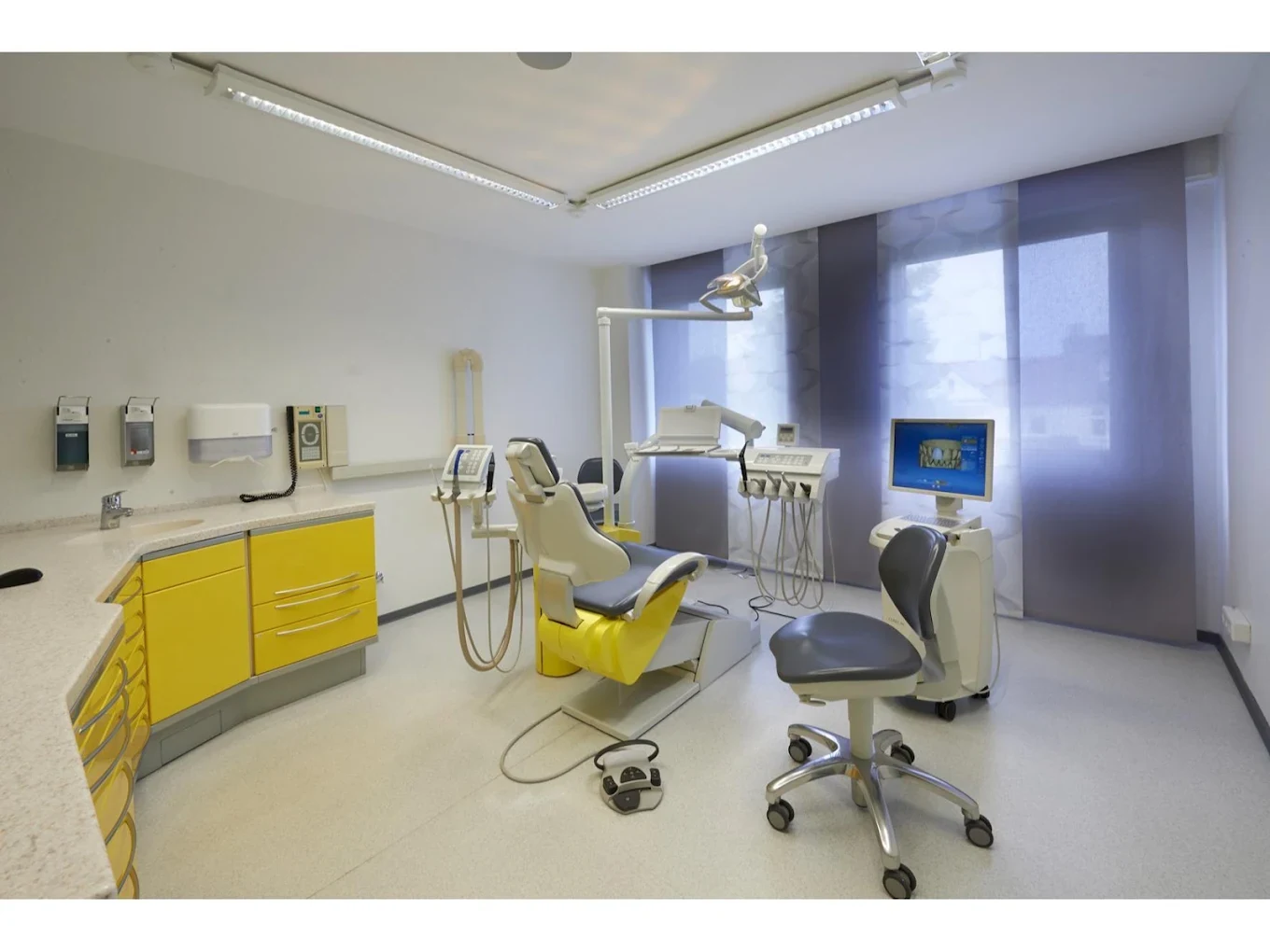
At the practice in Essen-Rüttenscheid, implant treatment is planned and carried out by Dr. med.dent.J.Hayim M.Sc. M.Sc. In suitable cases, SICAT Suite and ICX-MAGELLAN X 5.4 are used for digital implant planning. When guided implant placement is appropriate, matching surgical guides can be 3D-printed in the practice.
A three-dimensional CBCT (DVT) scan is not automatically required for every implant. It is used when the additional three-dimensional information is medically justified for diagnosis or planning.
Request an appointment online · Call +49 201 48682900
What does a dental implant replace?
The implant itself initially replaces the tooth root. After healing, it can support — depending on the treatment — a crown, a bridge construction or an attachment for removable dental prostheses.
An implant-supported restoration therefore consists of several components. In everyday language, the complete restoration is often called an “implant”; medically, it is useful to distinguish between the implant body in the bone and the dental restoration attached to it.
An implant cannot reverse the loss of a natural tooth. In suitable situations, however, it can provide a way to restore function without necessarily preparing neighbouring teeth solely to serve as abutments for a conventional bridge.
When can dental implants be considered?
Typical situations include:
- one missing tooth,
- several missing teeth,
- larger edentulous areas,
- a completely edentulous jaw where implants are intended to support or retain a prosthesis.
The number of implants required cannot be determined from these categories alone. It depends on the planned prosthetic restoration, bone and soft-tissue conditions, functional loading and other individual factors.
Equally important is whether an implant is actually the most appropriate option. Depending on the situation, a conventional bridge or removable dental prosthesis may be alternatives.
What is assessed before implant placement?
Both the local oral situation and relevant general health factors need to be considered before implant planning.
Teeth and gums
Active inflammation and diseases requiring treatment should be included in the treatment plan and, where appropriate, treated first. The periodontal condition is particularly important because long-term implant health requires controllable oral hygiene and stable inflammatory conditions.
Available bone and anatomical structures
The position, form and available bone for the planned implant need to be assessed. Nearby structures such as nerves, the maxillary sinus and adjacent teeth must also be considered.
If the available bone is insufficient for the planned implant position, bone augmentation may be required in selected cases. This is not an automatic additional procedure for every implant; it is decided according to the individual anatomy and planned restorative concept.
General health and medication
General medical conditions and medications can be relevant to implant planning. Examples include diabetes and medicines that affect bone metabolism. Current implantology guidelines illustrate why individual assessment is more appropriate in such risk situations than blanket statements such as “implants always work” or “implants are always excluded with this condition”.
Please therefore bring an up-to-date medication list and report relevant medical conditions during the medical history.
Smoking and individual risk factors
Smoking can also influence the risk of complications. A responsible consultation therefore considers not only technical feasibility, but also the factors that may make healing and long-term maintenance more difficult.
Is CBCT always required for dental implants?
No.
Every implant treatment requires a clinical examination and appropriate radiographic diagnostics. A three-dimensional CBCT (DVT) scan is not, however, automatically necessary for every implant.
The current S2k guideline on dental cone-beam computed tomography requires a justified indication for three-dimensional imaging. It also notes that a general improvement in implant-treatment outcomes through 3D imaging has not been demonstrated.
The practice has a Dentsply Sirona Orthophos 2D/3D system available. CBCT is used when three-dimensional information is medically useful for the specific anatomical or surgical question — not as a routine technology feature for every patient.
Digital implant planning and guided surgery at the practice
When three-dimensional planning is indicated, the implant position and relevant anatomical structures can be assessed digitally and the planned prosthetic restoration incorporated into the planning process.
The practice uses SICAT Suite and ICX-MAGELLAN X 5.4 for this purpose.
Where indicated, this can lead to a guided-surgery workflow: the digitally planned implant position is transferred to a surgical guide that can support implementation of the plan during surgery. Suitable guides can be manufactured in the practice using the available 3D-printing workflow.
A surgical guide is nevertheless not a blanket promise of quality and does not replace surgical assessment. Not every implant procedure requires guided placement.
What is the typical implant-treatment process?
The sequence depends on the initial situation and the planned restoration. It can generally be divided into several phases.
1. Examination and treatment planning
The gap, neighbouring teeth, gums, bite and relevant health factors are assessed first. The necessary radiographic diagnostics depend on the clinical question.
At this stage, alternatives to implants should also be discussed and the eventual restoration planned. Implant surgery and the prosthetic restoration should not be treated as two unrelated decisions.
2. Implant placement
The implant is surgically placed in the planned position in the jawbone. Whether a conventional or guided approach is used depends on the individual case.
If the available bone is insufficient, bone augmentation may be required. Depending on the situation, this may take place before or in connection with implant placement. There is no single universal approach.
3. Healing phase
After placement, the tissues need time to heal and the implant needs time for osseointegration. The duration varies and depends on factors such as implant position, bone quality, any additional augmentation, healing and the planned loading concept.
For this reason, we do not state one universal healing time for every patient.
4. Prosthetic restoration
After the planned healing and loading phase, the implant receives its prosthetic restoration.
For implant crowns, The practice uses a digital workflow with an intraoral scanner over two appointments. The specific restoration and manufacturing pathway depend on the individual case.
Are immediate implant placement, immediate restoration and immediate loading the same thing?
No. These terms describe different decisions.
Immediate implant placement means that an implant is placed directly after a tooth has been removed.
Immediate restoration means that a provisional prosthetic restoration is placed promptly on or in connection with the implant.
Immediate loading refers to functional loading of the implant during an early phase.
At the practice, such concepts may be used when clinically indicated. They are not a standard promise for every missing tooth. Factors such as primary stability, bone and soft-tissue conditions, implant position and the planned restoration need to be considered.
“Fixed teeth immediately” is therefore not a responsible universal guarantee.
When may bone augmentation be necessary?
After tooth loss, the available bone can change. If the existing bone is insufficient for the planned implant position, augmentation may become part of the treatment concept.
The extent of augmentation and whether it can be carried out at the same time as implant placement depend on the individual situation. Marked bone loss neither automatically makes implants impossible nor means that augmentation can make implant placement possible in every case.
A specific diagnostic basis is required for the decision.
What advantages can implants have compared with a bridge?
For a single-tooth gap, an implant may allow the missing tooth to be replaced without preparing neighbouring teeth solely to support a conventional bridge.
Implants can also be used to retain or support dental prostheses when several or all teeth are missing.
This does not mean that implants are fundamentally “better”. A bridge may be appropriate in certain situations, especially when neighbouring teeth already require extensive restorative treatment. Removable dental prostheses may also be an appropriate option.
The correct decision depends on the condition of the remaining teeth, bone, treatment burden, ability to maintain hygiene, cost and personal priorities.
What risks and complications are possible?
Implant placement is a surgical procedure. General and implant-specific complications therefore need to be discussed individually before treatment.
Depending on the region and procedure, these may include:
- pain, swelling and postoperative bleeding,
- infection and wound-healing problems,
- injury to or impairment of neighbouring anatomical structures,
- absent or inadequate integration of the implant,
- technical problems involving the implant or restoration,
- inflammation of the tissues around the implant,
- and later repairs, additional treatment or loss of the implant.
The individual risk depends on the patient and the planned operation. A blanket success rate or guarantee of implant longevity would therefore be misleading.
What are peri-implant inflammatory diseases?
Implants require long-term care and monitoring.
With peri-implant mucositis, the soft tissues around an implant are inflamed. With peri-implantitis, inflammatory bone loss around the implant is also present. A current S3 guideline specifically addresses treatment of peri-implant infections.
This illustrates an important difference from advertising claims about “maintenance-free artificial teeth”: implants cannot develop caries, but the tissues around them can develop inflammatory disease.
Consistent oral hygiene at home, professionally coordinated preventive care and regular examinations therefore remain important after implant treatment has been completed.
How long does a dental implant last?
No fixed lifespan can be guaranteed for an individual patient.
Implants can function over the long term, but prognosis depends on numerous factors: the initial findings, healing, implant position, prosthetic loading, oral hygiene, peri-implant health, general medical conditions, smoking and regular follow-up can all play a role.
The restoration on an implant should also not be equated with the implant body itself. A crown or other prosthetic component may require repair or replacement even while the implant remains integrated in the bone.
How much do dental implants cost at the practice?
The practice does not publish one blanket fixed price for dental implants.
Total cost depends, among other factors, on:
- the number of implants planned,
- the diagnostics required,
- whether bone augmentation is necessary,
- the planned surgical approach,
- the restoration planned on the implant,
- and the individual clinical and laboratory requirements.
After examination and planning, you will receive detailed written cost information.
For patients with German statutory health insurance, possible reimbursement depends particularly on the prosthetic restoration and the individual insurance situation. A blanket reimbursement promise would therefore not be appropriate.
Implant, bridge or removable dental prosthesis?
This decision should not be based solely on the desire for something “fixed”.
Implant
Can restore a gap without requiring neighbouring teeth to be prepared solely as bridge abutments. It does, however, require surgery, appropriate clinical conditions and long-term implant maintenance.
Tooth-supported bridge
Can be a reasonable alternative, particularly when neighbouring teeth already require major restorations. The abutment teeth are incorporated into the restoration.
Removable dental prosthesis
Can provide a functionally and economically different option for larger gaps or extensive tooth loss. Depending on the concept, implants can also be used to stabilise removable prostheses.
Implantology with Dr. Hayim
Dr. med.dent.J.Hayim M.Sc. M.Sc. holds Master of Science qualifications in Implantology and in Oral Implantology and Periodontology.
For patients, however, the academic title alone is not a treatment recommendation. What matters is whether an implant is appropriate for the specific findings, which alternatives exist and whether the risk-benefit balance is reasonable for the planned treatment.
Digital planning with CBCT, SICAT Suite, ICX-MAGELLAN X 5.4 and 3D-printed surgical guides is available, but each step is used only when clinically justified.
Frequently asked questions about dental implants
Is a dental implant suitable for everyone?
No. Oral health, bone volume, general medical conditions, medication, smoking, ability to maintain the restoration and the planned prosthetic treatment can all influence suitability. An individual examination is therefore required.
Do I always need a 3D X-ray for an implant?
No. CBCT is used when three-dimensional information is medically justified. Automatically performing CBCT for every implant would not be an appropriate general rule.
What does guided surgery mean?
With guided surgery, a digitally planned implant position is transferred to the surgical procedure using a surgical guide. The practice uses SICAT Suite and ICX-MAGELLAN X 5.4 for suitable cases; matching guides can be 3D-printed in the practice.
Can an implant be placed immediately after a tooth is removed?
Immediate implant placement is possible in selected situations. Whether it is appropriate depends on local anatomy, infection status, bone and soft tissue, and the achievable implant stability. It is not standard for every extracted tooth.
Do I always need bone augmentation?
No. Bone augmentation is considered only when the available bone is insufficient for the planned implant or restorative concept. Type and extent are individual.
How long does an implant need to heal?
There is no responsible universal time period. Implant region, bone, additional augmentation, stability, healing and the loading concept all influence the schedule.
Can an implant develop inflammation?
The implant itself cannot develop caries. The surrounding tissues can, however, become inflamed. Peri-implant mucositis and peri-implantitis are important reasons for consistent oral hygiene and follow-up care.
What is the success rate?
Studies can report survival and success rates for defined patient groups and time periods. These figures cannot provide an individual guarantee. We therefore deliberately do not use a blanket success rate as an advertising promise on this page.
How much does a single dental implant cost?
A reliable total price cannot be derived from the number of implants alone because diagnostics, possible augmentation, surgical requirements and the later restoration all affect total cost. After individual planning, The practice provides written cost information.
Dental implant consultation in Essen-Rüttenscheid
If a tooth is missing or an existing restoration needs to be replanned, we first clarify the starting situation and the possible treatment pathways. An implant consultation should answer not only whether an implant is technically possible, but whether it is appropriate for your situation compared with the alternatives.
Dr. med.dent.J.Hayim M.Sc. M.Sc. Rüttenscheider Str. 194–196 45131 Essen
Phone: +49 201 48682900 Email: praxis@hayim.de
Patient communication and appointment scheduling are supported in German, English, French, Spanish and Turkish. The AI telephone assistant can also arrange appointments in these five languages.
Request an appointment online · Call · Request a callback
Professional basis
For the medical review of this page, current or still-applicable guidelines from the AWMF/DGZMK/DGI environment were used. These include in particular the S2k guideline on dental cone-beam computed tomography for indication-based 3D diagnostics, as well as current S3 guidelines on implant-related risk situations and peri-implant infections.
Practice-specific information about SICAT Suite, ICX-MAGELLAN X 5.4, guided surgery, 3D-printed surgical guides, Orthophos 2D/3D and Dr. Hayim's qualifications comes from verified practice information. Manufacturer documentation is used only to describe technical system functions accurately and not as evidence of better patient outcomes.
Editorial review date: 8 August 2026. This page does not replace an individual dental examination, informed consent or treatment planning.
Sources
- S2k-Leitlinie Dentale digitale Volumentomographie · AWMF
- www.dgzmk.de · www.dgzmk.de
- www.awmf.org · AWMF
- www.awmf.org · AWMF