
Root Canal Treatment in Essen-Rüttenscheid: Preserving a Tooth with an Inflamed Pulp
Root canal treatment at the practice in Essen-Rüttenscheid: when it is needed, how it is carried out, which technology is used and which alternatives may be considered.
Short answer
Root canal treatment at the practice in Essen-Rüttenscheid: when it is needed, how it is carried out, which technology is used and which alternatives may be considered.
Root canal treatment may become necessary when the tissue inside a tooth — the dental pulp — has become irreversibly inflamed or has already died. The objective is not simply to “quiet” the tooth, but to remove diseased tissue from the root canal system, clean the canals and seal them so that the tooth can be preserved where reasonably possible.
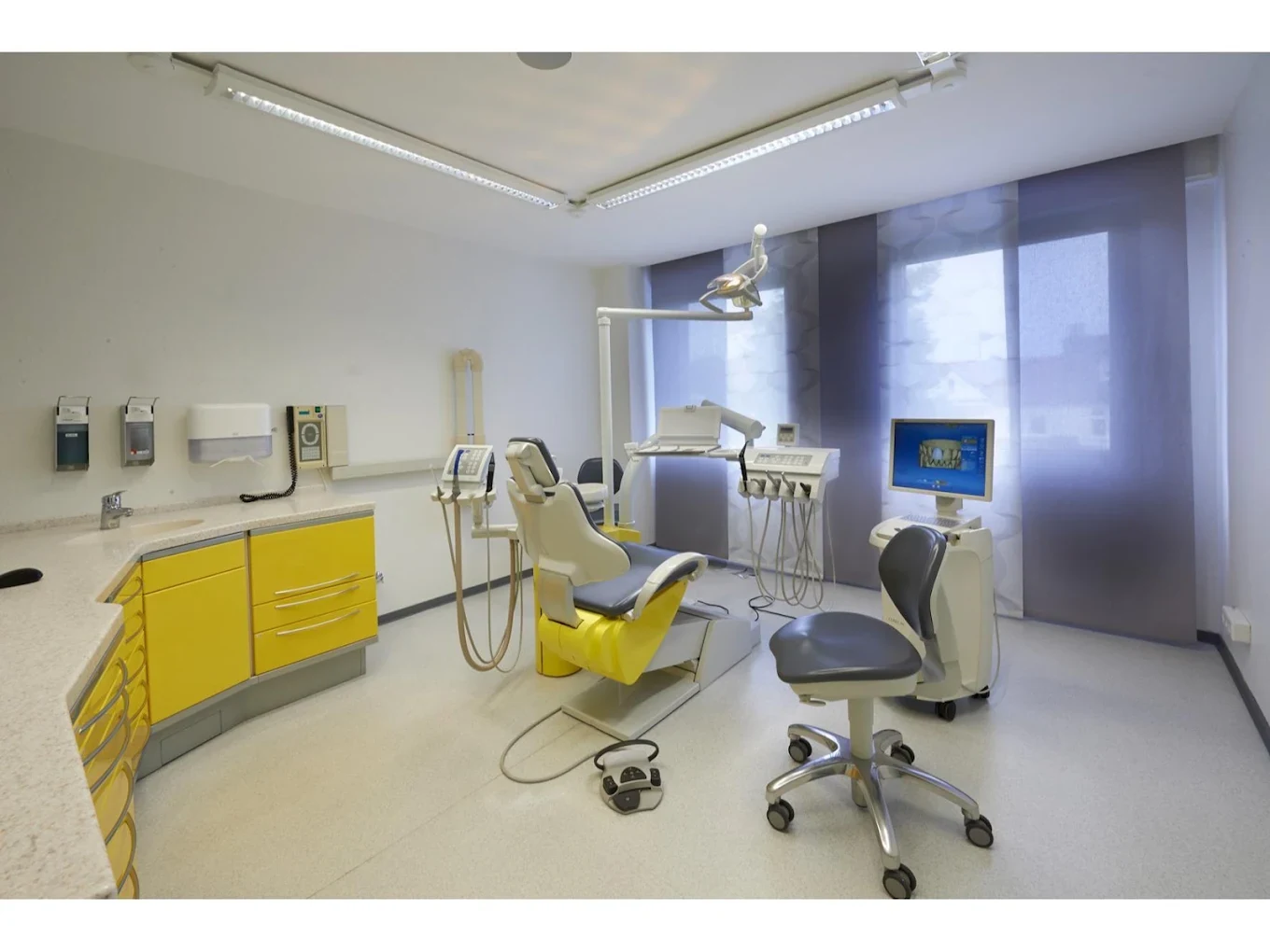
At the practice in Essen-Rüttenscheid, endodontic treatment is generally carried out using magnifying loupes. For difficult, markedly curved or calcified canals, a surgical microscope can additionally be used as a private supplementary service. Morita DentaPort Root ZX is available for electronic working-length determination; depending on the case, irrigation can be activated using the Dentsply Sirona SmartLite Pro EndoActivator. Laser may also be used as a supplementary private service in selected cases.
CBCT (DVT) is not routinely performed for every root canal treatment. It is considered only when conventional diagnostics do not adequately clarify the anatomy or cause of a problem and additional three-dimensional information is medically justified.
Request an appointment online · Call +49 201 48682900
Why can root canal treatment become necessary?
Inside a tooth, blood vessels and nerve fibres are contained within the pulp. If this tissue is severely irritated, irreversibly inflamed or damaged by bacterial infection, endodontic treatment may be required.
Possible causes include:
- deep caries,
- cracks or fractures,
- extensive older restorations,
- trauma to the tooth,
- or other irritation that causes lasting damage to the pulp.
If the pulp dies, bacteria can spread through the root canal system. Inflammation may then also affect the tissues around the root tip.
The decision to perform root canal treatment is therefore not made on the basis of one symptom alone. Depending on the situation, assessment may include clinical examination, sensibility tests, percussion testing and radiographic diagnostics.
What symptoms can indicate a problem inside the tooth?
Possible symptoms include:
- spontaneous toothache,
- a prolonged response to cold or heat,
- pain when chewing or biting,
- tenderness or pressure sensitivity,
- swelling,
- or tooth discolouration after trauma.
These signs are not specific enough for self-diagnosis.
A severely painful tooth does not automatically need root canal treatment. Conversely, a tooth with a necrotic pulp can sometimes cause few symptoms for a period of time. Dental diagnosis is therefore decisive.
Swelling, fever, marked general illness or rapidly worsening symptoms should be assessed promptly.
What is the aim of root canal treatment?
The aim is to preserve a tooth that has a reasonable prospect of being retained.
Diseased pulp tissue and microbial contamination in the root canal system need to be reduced as far as possible, the canals prepared and then filled in a way that makes renewed bacterial colonisation more difficult.
Root canal treatment does not make a tooth “alive” again. The treated tooth can, however, remain functional and subsequently receive an appropriate definitive restoration.
The principle of preserving a natural tooth does not mean that every tooth should undergo root canal treatment at any cost. With extensive fractures, very poor remaining tooth structure or other unsolvable problems, prognosis can be poor enough that extraction is the more appropriate option.
What is examined before root canal treatment?
Before treatment, it is assessed whether the symptoms actually originate from the dental pulp and whether the tooth appears worth preserving.
Depending on the situation, this may include:
- clinical examination,
- testing for percussion or pressure sensitivity,
- cold or other sensibility tests,
- assessment of existing fillings or crowns,
- radiographs,
- and further diagnostics for complex questions.
The condition of the tooth above the gum line is also important. A technically successful root canal treatment has limited value if the tooth cannot later be restored with a durable seal.
When is CBCT useful for root canal treatment?
Three-dimensional CBCT can provide additional information in selected endodontic situations — for example, when complex canal anatomy, unusual anatomy, resorptions or other findings cannot be assessed adequately with conventional information.
The practice has a Dentsply Sirona Orthophos 2D/3D system available for such indications.
The same principle applies: CBCT is not a standard image for every root canal treatment. Three-dimensional imaging involves additional radiation exposure and therefore requires medical justification.
The availability of the technology is not presented as a blanket promise of quality or treatment success.
How is root canal treatment carried out?
The precise procedure depends on the tooth, number of canals, anatomy, infection status and any previous treatment.
1. Local anaesthesia and access to the canal system
The tooth is generally anaesthetised locally. Access is then created to the inside of the tooth so that the root canals can be located and treated.
Anaesthesia can be more challenging when tissue is severely inflamed. It would therefore be too absolute to state that root canal treatment is always completely pain-free. The aim is to make treatment as tolerable as possible using appropriate local anaesthesia.
2. Visualisation and location of the canals
Root canal systems vary greatly. Canals may be narrow, curved, branched or difficult to access because of calcification.
At the practice, endodontic treatment is generally carried out under magnification with loupes. A surgical microscope can additionally be used for difficult curved or calcified canals.
Magnification can make structures easier to identify. It does not replace clinical experience or careful mechanical and chemical preparation.
3. Determining the working length
The canals need to be treated to an appropriate working length. Radiographic information is combined with other measuring methods for this purpose.
The practice uses Morita DentaPort Root ZX for electronic working-length determination.
Electronic measurement is an additional diagnostic and technical component. It is not presented as proof that every treatment will automatically be successful.
4. Mechanical preparation
Endodontic instruments are used to enlarge and shape the root canals so that infected or necrotic tissue can be removed and subsequent cleaning supported.
This can be particularly demanding in narrow or curved canals, so treatment effort can differ substantially from one tooth to another.
5. Irrigation and chemical cleaning
Instruments cannot mechanically reach every irregularity in a complex root canal system. Chemical irrigation is therefore an essential part of treatment.
In suitable cases at the practice, the irrigating solution can be activated using the Dentsply Sirona SmartLite Pro EndoActivator. Activation is intended to support movement of the irrigant within the canal system.
Laser can also be used as a private supplementary service in selected endodontic cases.
The correct context is important: neither EndoActivator nor laser replaces basic mechanical preparation, irrigation and the overall disinfection strategy. They are additional tools within a larger treatment process.
6. Root canal filling
After adequate cleaning and preparation, the canals are filled and sealed.
The root filling is intended to seal the prepared canal system as effectively as possible and reduce the likelihood of renewed bacterial colonisation.
7. Definitive restoration of the tooth
After endodontic treatment, the tooth needs a durable seal and an appropriate mechanical restoration.
Depending on the amount of tooth structure lost, possible options may include a direct filling, onlay, partial crown or full crown. Not every root canal-treated tooth automatically requires the same restoration.
Does root canal treatment always require several appointments?
No — but one appointment is not realistic for every case either.
The number of visits depends, among other factors, on:
- whether this is primary treatment or a revision,
- how many canals are present,
- how accessible the anatomy is,
- whether there is pronounced infection,
- whether an intracanal medicament between appointments is appropriate,
- and how the tooth responds during treatment.
Treatment planning therefore follows the findings rather than a fixed number of appointments.
Is root canal treatment painful?
Root canal treatment is usually carried out under local anaesthesia.
Nevertheless, pain perception differs between patients, and severely inflamed teeth can be more difficult to anaesthetise completely. Temporary tenderness after treatment can also occur.
For this reason, the responsible wording is not “root canal treatment is painless”, but that treatment is performed with appropriate anaesthesia and pain management and adapted to the patient's clinical situation.
What are the chances of success?
No responsible success rate can be guaranteed for an individual tooth.
Prognosis depends on factors including:
- the starting diagnosis,
- extent of infection,
- root canal anatomy,
- previous treatment,
- technical feasibility,
- remaining tooth structure,
- definitive restoration,
- and later oral health.
Primary treatment of an accessible tooth is not directly comparable with revision of a complex tooth that has already undergone several procedures.
We therefore do not use a blanket success percentage as an advertising promise.
What is root canal retreatment or revision?
If a previously root canal-treated tooth develops new symptoms or inflammation appears around the root tip, endodontic revision can be considered in selected cases.
This involves attempting to remove existing root filling material, regain access to the canal system, clean it again and reseal it.
Revision can be considerably more technically demanding than primary treatment, for example where there are:
- very narrow or curved canals,
- existing posts,
- materials that are difficult to remove,
- instrument fragments,
- or complex anatomy.
Whether revision is appropriate depends on whether the tooth is worth preserving and technically treatable.
When is apical surgery considered?
An apicoectomy or root-end surgery is a surgical procedure at the tip of a root.
It may be considered in selected situations where inflammation around the root tip persists despite orthograde root canal treatment or where conventional access through the tooth is not reasonably possible.
It is not automatically the next step after every root canal treatment.
Before surgery, it should be assessed whether orthograde revision is possible and appropriate. The decision and treatment sequence depend on the individual findings.
When does a tooth still need to be extracted despite endodontic treatment?
Root canal treatment is only useful when the tooth can subsequently remain functional.
Extraction may be necessary or more appropriate, for example, when:
- the tooth has a fracture that cannot be restored,
- too little load-bearing tooth structure remains,
- severe periodontal damage significantly limits prognosis,
- the canal system cannot reasonably be treated,
- or other clinical factors weigh against preserving the tooth.
The alternative to root canal treatment is not automatically an implant. After extraction, options may include an implant, bridge or removable dental prosthesis depending on the situation.
How much does root canal treatment cost?
Costs depend on the individual treatment.
For patients covered by German statutory health insurance, root canal treatment can be part of contractual dental care under certain conditions. At the same time, there are supplementary endodontic services that are not, or are not fully, covered by statutory insurance.
At the practice, the following supplementary endodontic procedures are available as private services:
- surgical microscope for difficult curved or calcified canals,
- electronic working-length measurement with Root ZX,
- irrigation activation with EndoActivator,
- and laser application in selected cases.
Whether these measures are appropriate in your case is discussed before treatment. No blanket private package fee is stated on this page.
A reliable cost estimate requires the diagnosis, tooth position, treatment scope and clarification of whether the case is primary treatment or revision.
What role does the surgical microscope play?
A surgical microscope can provide greater magnification and targeted illumination in difficult endodontic situations.
At the practice, it is used as a private supplementary service for difficult curved or calcified canals.
This is deliberately a narrow claim. We do not state that every root canal treatment requires a microscope or that the microscope alone determines treatment success.
Magnifying loupes are routinely used for general endodontic treatment in the practice.
What role does laser play?
Laser can be used as an adjunctive instrument within selected endodontic protocols.
At the practice, laser may be used as a private supplementary endodontic service.
It is not presented as a replacement for mechanical canal preparation, irrigation or root filling. It would likewise be irresponsible to describe a treatment as “bacteria-free”, “risk-free” or guaranteed to succeed simply because a laser is used.
Why is the final restoration important after root canal treatment?
Root canal treatment addresses the inside of the tooth. Afterwards, the remaining question is how the tooth above the gum line can be restored with sufficient strength and a durable seal.
Severely damaged posterior teeth may need additional mechanical stabilisation. Other teeth may be restored with a smaller restoration.
The decision is based not merely on the fact that root canal treatment was performed, but particularly on the amount of remaining tooth structure and the functional load.
This restorative planning is an important part of long-term prognosis.
Frequently asked questions about root canal treatment
Does every inflamed tooth need root canal treatment?
No. It first needs to be established what type of pulp disease is present and whether the tooth is worth preserving. Not every temporary irritation of the dental pulp requires root canal treatment.
Can a dead tooth still hurt?
Yes. Even after the pulp has died, inflammation around the root tip or in surrounding tissues can cause symptoms.
Does the practice use a microscope for every root canal treatment?
No. Endodontic treatment is generally performed using magnifying loupes. A surgical microscope can be used as a private supplementary service for difficult curved or calcified canals.
Is CBCT performed for every root canal treatment?
No. CBCT is used only when conventional diagnostics cannot adequately answer a relevant anatomical or pathological question and additional three-dimensional information is medically justified.
What is Root ZX?
Root ZX is an electronic system for determining working length within the root canal. The practice uses Morita DentaPort Root ZX as a private supplementary endodontic service.
What does EndoActivator do?
The Dentsply Sirona SmartLite Pro EndoActivator activates irrigating solution within the root canal. It supplements mechanical preparation and chemical irrigation but does not replace them.
Can laser help with root canal treatment?
Laser can be used as an adjunct in selected endodontic cases. at the practice, this is a private supplementary service. Its use does not guarantee freedom from symptoms or treatment success.
How many appointments do I need?
This depends on the tooth, number of canals, anatomy, infection status and any previous treatment. One appointment may be possible, while several appointments can also be appropriate or necessary.
Does every root canal-treated tooth need a crown?
No. The subsequent restoration depends on remaining tooth structure, tooth position and functional loading. Depending on the situation, a filling, onlay, partial crown or crown may be appropriate.
What happens if root canal treatment does not heal successfully?
The cause is assessed first. Depending on the findings, revision, apical surgery or extraction may be considered. The appropriate option depends on whether the tooth is worth preserving and technically treatable.
Discuss root canal treatment in Essen-Rüttenscheid
If a tooth is causing severe pain or inflammation of the dental pulp is suspected, diagnosis comes first. Root canal treatment is appropriate when the tooth is worth preserving and the treatment offers a reasonable prognosis.
Dr. med. dent. J. Hayim M.Sc. Rüttenscheider Str. 194–196 45131 Essen
Phone: +49 201 48682900 Email: praxis@hayim.de
Patient communication and appointment scheduling are supported in German, English, French, Spanish and Turkish.
Request an appointment online · Call · Request a callback
Professional basis
The medical information on this page was reviewed in particular against patient information and professional publications from the German Society of Endodontology and Dental Traumatology (DGET), together with DGZMK/AWMF material on endodontic diagnosis and treatment.
The DGET describes root canal treatment as a tooth-preserving procedure and provides patient information on primary treatment, revision, costs and other endodontic questions. Current guidance on apical surgery was considered for surgical follow-up options.
Practice information on magnifying loupes, surgical microscope, Morita DentaPort Root ZX, SmartLite Pro EndoActivator, laser and indication-based CBCT comes from verified clinic information. No claims of success or superiority are derived from the technical devices.
Editorial review date: 8 August 2026. This page does not replace an individual dental examination, diagnosis, informed consent or treatment planning.
Further information
Sources
- DGET: Erhalte Deinen Zahn · DGET: Erhalte Deinen Zahn
- DGET: Patienteninformationen · DGET: Patienteninformationen
- DGET: Endodontologie / endodontische Schmerzbehandlung · DGET: Endodontologie / endodontische Schmerzbehandlung
- DGZMK: Good clinical practice — Die Wurzelkanalbehandlung · DGZMK: Good clinical practice — Die Wurzelkanalbehandlung
- DGZMK / AWMF: Dentale digitale Volumentomographie · DGZMK / AWMF: Dentale digitale Volumentomographie
- AWMF: Wurzelspitzenresektion guideline register · AWMF