
Dental Fillings in Essen-Rüttenscheid: Composite or Ceramic?
Dental fillings at the practice in Essen-Rüttenscheid: composite, ceramic inlays and onlays, amalgam alternatives, procedure, durability and costs explained clearly.
Short answer
Dental fillings at the practice in Essen-Rüttenscheid: composite, ceramic inlays and onlays, amalgam alternatives, procedure, durability and costs explained clearly.
A dental filling replaces hard tooth structure lost through caries, a defect or replacement of a restoration that is no longer intact. The appropriate treatment depends not only on the size of the cavity but also on tooth position, functional loading, the ability to maintain a dry working field and the amount of healthy tooth structure remaining.
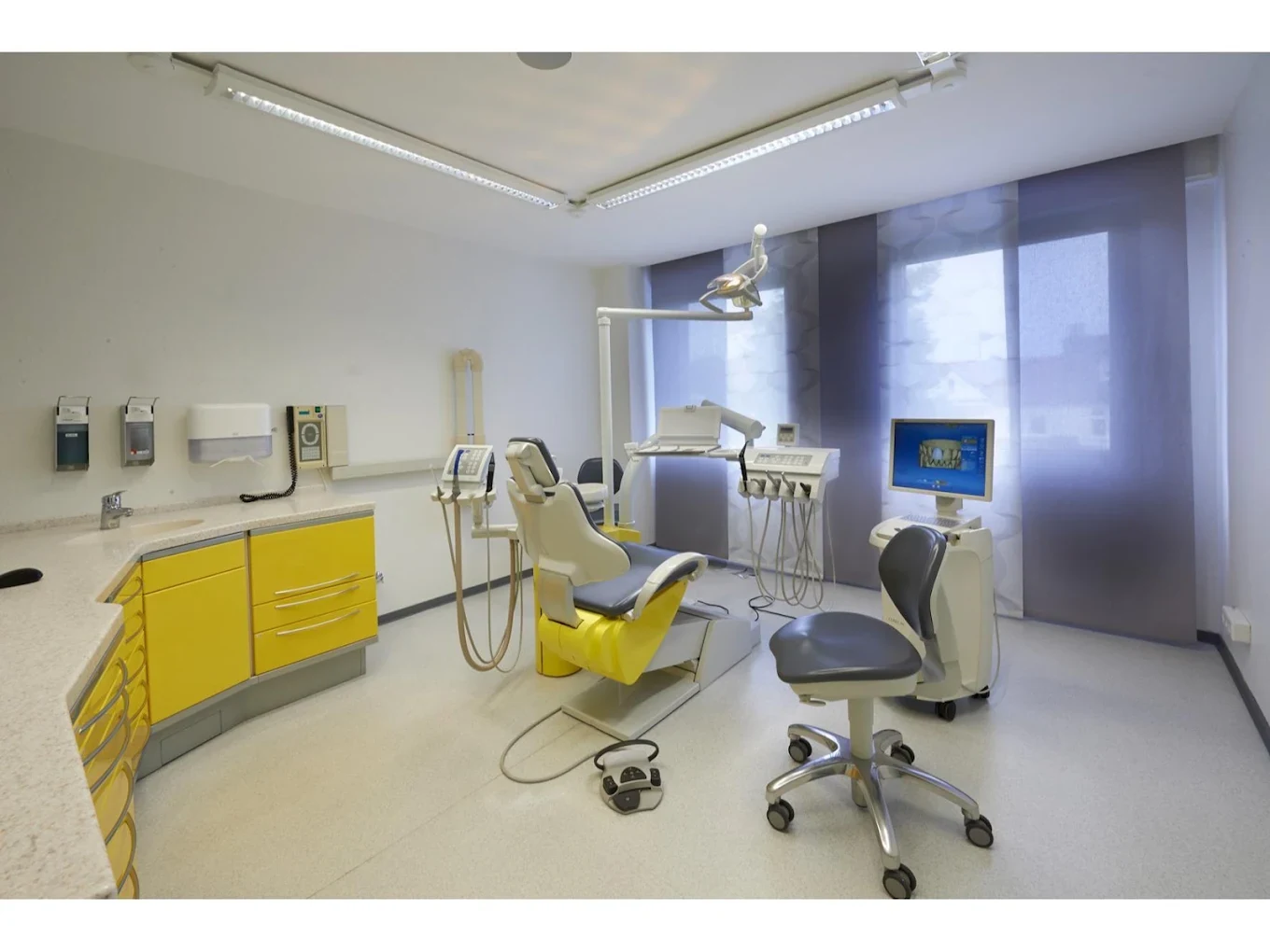
The dental practice in Essen-Rüttenscheid is an amalgam-free practice. High-quality composite material from Kuraray Noritake is used for direct tooth-coloured restorations. The specific product depends on the clinical situation; one single product is not used uniformly for every case.
With larger defects, an indirect ceramic restoration such as an inlay or onlay may be more appropriate than a direct filling. The practice's digital CEREC workflow is available for suitable cases; inlays and onlays can then be manufactured in one appointment.
Request an appointment online · Call +49 201 48682900
When does a tooth need a filling?
A filling may be needed when tooth structure has been lost and the defect requires restoration.
Common reasons include:
- caries,
- fractured tooth structure,
- defective or leaking older fillings,
- smaller fractures,
- or replacement of an existing restoration when there is a medical indication.
Not every discoloured or older filling automatically needs to be replaced. What matters is whether there is a clinically relevant defect, marginal gap, secondary caries, fracture or another reason for treatment.
What is a composite filling?
Composite is a tooth-coloured restorative material consisting of a resin matrix and inorganic filler particles.
It is placed into the prepared tooth in a mouldable form and cured in stages. Adhesive bonding allows the restoration to be attached to the remaining tooth structure.
The current German S3 guideline on direct composite restorations supports the use of composite for a broad range of anterior and posterior defects. The decision nevertheless remains dependent on the individual defect and clinical situation.
The practice uses composite material from Kuraray Noritake for direct restorations.
Why does defect size matter?
The larger the defect, the greater the mechanical demands on the restoration.
For small and medium-sized defects, a direct composite filling can often provide a conservative treatment option.
If larger areas of the occlusal surface or individual cusps are weakened or lost, it should be considered whether an indirect restoration such as an inlay, onlay or partial crown can manage the load more appropriately.
The boundary cannot reasonably be defined by one fixed millimetre measurement on a website. It depends on remaining tooth structure, tooth position, cracks, bite forces and other factors.
What is the difference between a filling, inlay and onlay?
Direct filling
A direct filling is built up and cured directly in the tooth. Composite is an important tooth-coloured material for this purpose.
Inlay
An inlay is an indirectly manufactured intracoronal restoration. It is produced outside the mouth or designed digitally and then fitted into the prepared tooth.
Onlay
An onlay additionally includes larger areas of the chewing surface and may cover one or more weakened cusps.
Functionally, an onlay therefore lies between a smaller indirect restoration and a more extensive partial crown.
The correct treatment is not determined simply by a preference for “ceramic instead of resin”, but by how much tooth structure can be preserved and which loads the restoration needs to withstand.
When can ceramic be more appropriate?
Ceramic inlays or onlays can be considered for larger defects when a direct filling is not the preferred treatment but a complete crown is not yet necessary.
Possible reasons include:
- larger defects subject to chewing forces,
- weakened cusps,
- high functional demands,
- or findings for which an indirect restoration appears more appropriate.
This does not mean ceramic is fundamentally “better” than composite. Direct composite restorations are evidence-based treatments and can be very appropriate depending on the defect.
CEREC inlays or onlays in one appointment
At the practice, suitable inlays and onlays can be digitally manufactured and fitted in one appointment.
The workflow may include:
- preparing the tooth,
- digital scanning with Primescan AC,
- digital design,
- machine manufacturing,
- material-specific finishing,
- try-in and checking,
- definitive bonding or cementation.
One-appointment treatment is possible in suitable cases but is not guaranteed for every tooth.
If material, defect size, aesthetic requirements or other clinical factors make a different workflow more appropriate, treatment may require more than one appointment.
Why is the practice amalgam-free?
The practice does not use dental amalgam for routine filling treatment.
Since 1 January 2025, dental amalgam may generally no longer be used routinely for dental treatment in the European Union. An exception remains where the dentist considers its use strictly necessary because of specific medical requirements of the individual patient.
The European regulation is primarily based on the objective of reducing mercury use for environmental reasons.
It should not be misinterpreted to mean that every existing amalgam filling is automatically harmful or must be removed as a precaution.
Do old amalgam fillings need to be removed?
No, not merely because the use of new amalgam restorations has been largely restricted since 2025.
An existing filling should be assessed like any other restoration:
- Is it intact?
- Are there marginal defects?
- Is secondary caries present?
- Is the tooth at risk of fracture?
- Are there symptoms or other medical reasons for replacement?
An intact amalgam filling should not be removed solely because of fear of the material.
If an existing filling needs to be replaced, the new restoration is planned according to the defect and clinical situation.
Which fillings are covered by German statutory health insurance?
Following the phase-out of routine amalgam use in 2025, patients with German statutory health insurance continue to be entitled to a contractual filling treatment without an additional patient charge.
Which materials are included in contractual care in a particular case, and when additional costs arise, depends on tooth region, defect and the selected procedure.
KZBV explicitly notes that the suitable filling material depends, among other things, on the size and location of the defect.
If a treatment goes beyond the applicable statutory benefit, any additional costs should be explained transparently before treatment.
Blanket statements such as “composite always costs extra” or “every tooth-coloured filling is free” would therefore be too imprecise.
How is a composite filling placed?
The exact procedure depends on the defect.
1. Diagnosis and caries removal
The size of the defect and the appropriate restoration are assessed first.
If caries is present, diseased tooth structure is removed. The objective is not to remove as much tooth as possible, but to create a stable and restorable situation.
2. Moisture control
A controlled working environment is important for adhesive composite restorations.
Saliva or blood can impair adhesive bonding. The method used to keep the area dry depends on the tooth and clinical situation.
3. Adhesive preparation
The tooth surface is prepared so that the composite can bond to the remaining tooth structure.
The specific adhesive system and protocol depend on the material and clinical situation.
4. Rebuilding the tooth shape
Composite is placed into the defect, shaped and light-cured.
For posterior teeth, this includes factors such as the contact with neighbouring teeth and the form of the chewing surface.
5. Finishing and bite check
Finally, the surface, margins and bite are checked and adjusted where necessary.
A filling should not simply close a cavity; it should fit functionally into the existing tooth form.
Does receiving a filling hurt?
Local anaesthesia can be used when treatment involves pain-sensitive areas.
Whether anaesthesia is necessary depends on factors including defect depth, tooth sensitivity and the treatment step.
A guarantee that every filling procedure will be completely pain-free would not be responsible. If you have sensitive teeth or dental anxiety, mention this before treatment begins.
How long does a composite filling last?
There is no fixed number of years that applies to every patient and every filling.
Long-term prognosis depends on factors including:
- defect size,
- tooth position,
- remaining tooth structure,
- loading,
- quality of moisture control and adhesive processing,
- oral hygiene,
- caries risk,
- clenching or grinding,
- and regular examinations.
The current S3 guideline regards direct composite restorations as evidence-based treatment options for numerous indications. This does not provide an individual durability guarantee.
Can caries develop again around a filling?
The filling material itself does not develop caries.
New caries can, however, develop in the natural tooth structure at the margin of a restoration when relevant risk factors are present.
Oral hygiene, fluoride exposure, dietary habits and regular examinations therefore remain important after a filling has been placed.
A new filling treats an existing defect but does not protect the tooth permanently against all future caries.
When does an old filling need to be replaced?
An older restoration does not need replacement merely because of its age.
Replacement may be considered where there is:
- new caries,
- fracture,
- significantly damaged margins,
- loss of part of the filling,
- symptoms,
- functional problems,
- or another clinically relevant defect.
In some situations, repair may be possible instead of completely replacing the restoration.
The decision should therefore be based on current findings rather than the age of the filling alone.
Can composite fillings be repaired?
In suitable situations, yes.
A limited repair can preserve more natural tooth structure than completely removing an otherwise largely intact restoration.
Whether repair is appropriate depends on the type, size and location of the defect and the condition of the existing filling.
The current S3 guideline on composite restorations also considers such minimally invasive restorative strategies.
What is important with very deep defects?
The closer a defect extends to the pulp, the more important the biological situation becomes.
Not every deep defect automatically leads to root canal treatment. Depending on the findings and the response of the pulp, different tooth-preserving measures may be considered.
If the pulp is irreversibly inflamed or necrotic, root canal treatment may become necessary.
Filling or crown — where is the boundary?
A crown is substantially more extensive than a direct filling and requires corresponding preparation of the tooth.
It can become appropriate when so much tooth structure has been lost that smaller restorations no longer offer sufficient stability.
Indirect partial restorations such as onlays or partial crowns sit between these options.
The choice is therefore not simply “filling or crown”. For many teeth there is a spectrum:
direct filling → inlay/onlay/partial crown → crown
The appropriate level depends on the individual defect.
Composite or ceramic — which is better?
Neither option is fundamentally better for every defect.
Composite may be appropriate when
- the defect can be restored directly,
- sufficiently controlled moisture isolation is possible,
- a conservative direct restoration is indicated,
- and the mechanical load is suitable for the restoration size.
Ceramic may be appropriate when
- a larger defect requires an indirect restoration,
- cusps or larger areas of the chewing surface need to be included,
- an onlay or inlay appears restoratively more suitable,
- and the tooth is suitable for an adhesively bonded indirect restoration.
The decision should be based on the tooth, not on a material trend.
How much does a dental filling cost at the practice?
There is no single website fixed price for dental fillings.
Costs depend on factors including:
- the tooth and defect size,
- selected material,
- direct or indirect restoration,
- treatment effort,
- and insurance status.
For patients with German statutory health insurance, a contractual treatment without additional cost may be possible. If a treatment beyond this benefit is selected, possible additional costs are discussed before treatment.
Ceramic inlays and onlays involve a different restorative process from a direct composite filling and are planned separately.
Frequently asked questions about dental fillings
Is the practice an amalgam-free practice?
Yes. Dental amalgam is not used for routine filling treatment in the practice.
Has amalgam been banned since 2025?
Since 1 January 2025, dental amalgam may generally no longer be used routinely in the EU. A narrowly defined medical exception remains where use is strictly necessary in an individual case.
Are existing amalgam fillings dangerous?
The European restrictions do not mean that every existing intact amalgam filling automatically needs to be removed. Existing restorations should be assessed according to their clinical condition.
Which composite does the practice use?
The practice uses high-quality composite material from Kuraray Noritake. One specific product is not uniformly defined for every clinical situation and is therefore not stated as a blanket product choice.
Is composite suitable only for small fillings?
No. The current S3 guideline supports direct composite restorations for a broad range of indications. For very large or mechanically unfavourable defects, indirect restorations may nevertheless be more appropriate.
Can ceramic inlays be manufactured in one appointment?
At the practice, suitable inlays and onlays can be manufactured in one appointment using the digital CEREC workflow. This is not a universal guarantee for every tooth.
Does every old filling have to be replaced?
No. Age alone is not sufficient reason. Clinical defects, caries, fracture, symptoms or other medical reasons are decisive.
Can a filling be repaired?
In suitable cases, repair can be possible and more conservative than complete replacement.
Do I always need an injection for a filling?
No. Whether local anaesthesia is needed depends on defect depth, sensitivity and the treatment being performed.
Which lasts longer: composite or ceramic?
There is no universal answer. Durability depends not only on the material but also on defect size, tooth, loading, processing, oral hygiene and caries risk.
Does statutory health insurance cover tooth-coloured fillings?
Following the 2025 amalgam phase-out, patients with German statutory health insurance continue to have access to contractual filling treatment without an additional charge. Whether a specific selected composite or other restoration creates additional costs depends on the clinical case and scope of service.
Discuss a dental filling in Essen-Rüttenscheid
If an old filling is damaged or a new defect has been identified, the first step is to determine how much tooth structure is affected and which restorative treatment is most appropriate.
Dr. med.dent.J.Hayim M.Sc. M.Sc. Rüttenscheider Str. 194–196 45131 Essen
Phone: +49 201 48682900 Email: praxis@hayim.de
Patient communication and appointment scheduling are supported in German, English, French, Spanish and Turkish.
Request an appointment online · Call · Request a callback
Professional basis
The medical information on this page was reviewed in particular against the current German S3 guideline on direct composite restorations and current information from KZBV and European regulation relating to the phase-out of routine dental amalgam use.
Practice information about Kuraray Noritake composite materials and the CEREC workflow comes from verified clinic information. Manufacturer information is used only to describe product or system characteristics and not to infer guaranteed superiority or durability.
Editorial review date: 8 August 2026. This page does not replace an individual dental examination, diagnosis or treatment plan.
Sources
- S1 DGZMK — Direkte Kompositrestaurationen an bleibenden Zähnen · S1 DGZMK — Direkte Kompositrestaurationen an bleibenden Zähnen
- S2 DGZMK Leitlinien overview · S2 DGZMK Leitlinien overview
- S3 KZBV — Welche Zahnfüllungen gibt es? · KZBV
- S4 KZBV — Einlagefüllungen · KZBV
- S5 KZBV — Amalgam ban / GKV filling coverage · KZBV
- S6 BZÄK — Amalgam / EU mercury regulation · Bundeszahnärztekammer (BZÄK)