Dental Restorations in Essen-Rüttenscheid: Which Option Suits Your Situation?
Dental restorations at the practice in Essen-Rüttenscheid: crowns, bridges, implant-supported restorations and dentures. Options, digital manufacturing, procedure and costs explained clearly.
Short answer
Dental restorations at the practice in Essen-Rüttenscheid: crowns, bridges, implant-supported restorations and dentures. Options, digital manufacturing, procedure and costs explained clearly.
Dental restorations may become necessary when a tooth is so extensively damaged that a direct filling is no longer sufficient, or when one or more teeth are missing. Depending on the starting situation, options can include crowns, bridges, implant-supported restorations and removable partial or complete dentures.
At the practice in Essen-Rüttenscheid, dental restorations are not planned as one standard solution. Relevant factors include which teeth are affected, how much load-bearing tooth structure remains, the condition of neighbouring teeth, the bite, and which treatment can be maintained effectively over the long term.
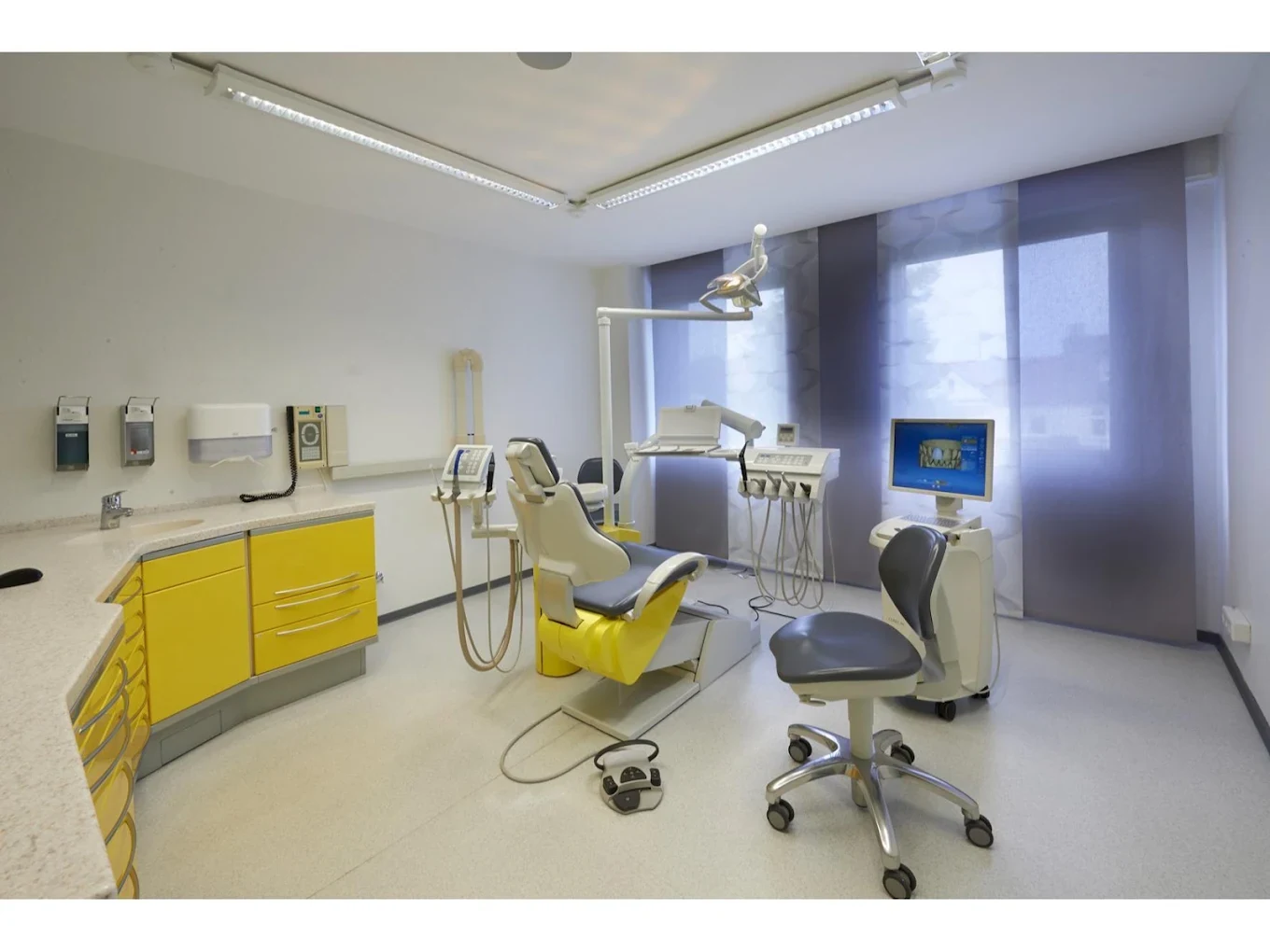
For selected fixed restorations, the practice has a digital CAD/CAM workflow with Primescan AC, MC XL, MC X5, inLab 22 and SpeedFire. Other restorations are produced in cooperation with dental laboratory partners. The appropriate manufacturing route depends on the material, scope and clinical situation.
Request an appointment online · Call +49 201 48682900
What counts as a dental restoration?
The term covers several different forms of treatment that vary substantially in what they replace and how they are supported.
Dental crowns
A crown can be considered when a tooth can still be preserved but has lost so much tooth structure that a smaller restoration is no longer sufficient. The existing tooth is prepared and then restored with an individually manufactured crown.
A crown therefore does not automatically replace a missing tooth. It reconstructs an existing tooth that requires treatment.
Dental bridges
A bridge can replace one or more missing teeth. Conventional tooth-supported bridges are anchored to neighbouring teeth, which generally need to be prepared accordingly.
This can be particularly appropriate when those abutment teeth already require larger restorations. If the neighbouring teeth are largely healthy, it should also be considered whether an implant could be an alternative.
Implant-supported restorations
An implant initially replaces the tooth root. A crown, bridge or other prosthetic restoration can then be attached to it.
Implant surgery and the final restoration therefore belong together in treatment planning, but they are not the same thing. The relevant question is not only “Can an implant be placed?” but also “What restoration is it intended to support later?”
Removable partial dentures
When several teeth are missing and a completely fixed solution is not appropriate or possible, a removable partial denture may be considered.
There are different designs depending on the remaining teeth and the overall restorative concept. The appropriate type cannot be determined from the number of missing teeth alone.
Complete dentures
If no natural teeth remain in a jaw, a complete denture can replace the missing teeth and parts of the lost tissue structures.
Different treatment concepts are also possible for complete edentulism. Implants can, for example, be used to provide additional retention for a removable denture or to support other implant-based restorations.
Fixed or removable: which is better?
There is no universal answer.
Fixed dental restorations include crowns and bridges as well as many implant-supported restorations. They remain fixed in the mouth and are not removed by the patient for cleaning.
Removable restorations can be appropriate when many teeth are missing, when the remaining teeth or bone limit other options, or when functional, medical or financial factors favour a removable concept.
“Fixed” is therefore not automatically medically better. A restoration is appropriate when it fits the remaining tooth structure, periodontal condition, functional loading, ability to maintain hygiene and the patient's goals.
When is a crown appropriate?
A crown may be necessary when a tooth has been weakened by caries, fracture, large existing fillings or other loss of tooth structure to the point that a direct filling or smaller partial restoration is insufficient.
Before planning a crown, the amount of load-bearing tooth structure should be assessed and a more conservative option considered where appropriate.
Depending on the defect, an inlay or onlay may be an alternative. These restore only part of the tooth and can preserve more natural tooth structure in suitable situations.
Even after root canal treatment, a crown is not automatically required for every tooth. The need for stabilisation depends on the amount of tooth structure lost, tooth position and future loading.
More about root canal treatment · More about dental fillings
When is a bridge appropriate?
A conventional bridge replaces a gap with the help of neighbouring abutment teeth. These teeth need to be incorporated into the treatment plan and generally prepared.
A bridge may be particularly appropriate when:
- neighbouring teeth already have large fillings or crowns,
- they require restorative treatment anyway,
- implant placement is medically unsuitable or not desired,
- or the overall restorative concept favours a bridge.
If the adjacent teeth are largely intact, the tooth structure that would need to be removed should be weighed against an implant-supported solution.
Neither option is fundamentally superior. The decision depends on the condition of the teeth, available bone, willingness to undergo surgery, treatment burden, maintenance and costs.
How are dental restorations planned digitally at the practice?
For many fixed restorations, the oral situation can be captured digitally with Primescan AC. This provides three-dimensional data for subsequent restorative planning.
Depending on the treatment, the restoration can then be designed and manufactured digitally in the practice or the data can be used in cooperation with a dental laboratory.
The digital practice workflow includes:
- Primescan AC for intraoral digital scanning,
- inLab 22 for digital design and manufacturing workflows,
- MC XL with four axes,
- MC X5 with five axes,
- SpeedFire for suitable ceramic workflows,
- and additional ceramic furnaces for more extensive work.
Technology alone does not determine which treatment is medically appropriate. Diagnosis and planning come first; the suitable manufacturing pathway is chosen afterwards.
Can a crown be made directly at the practice?
In suitable cases, yes.
Selected feldspathic and lithium-disilicate crowns can be manufactured digitally in the practice workflow using MC XL. In appropriate workflows, the pure CAD/CAM production step can be relatively short.
This does not mean that every crown can be completed in 30 minutes or that every full treatment can be finished in one appointment.
Depending on the case, tooth preparation, digital scanning, design, material processing, possible crystallisation or characterisation, try-in, occlusal checks and adhesive or conventional cementation are also part of the process.
Material and restoration are therefore selected according to the clinical situation and restorative objective, not simply according to the shortest machine time.
How are zirconia restorations manufactured?
Zirconia can also be part of the digital practice workflow. SpeedFire is available for suitable restorations and is designed for corresponding ceramic processing steps.
In suitable situations, zirconia crowns can be produced and thermally processed comparatively quickly within the practice workflow.
Again, technical production time is not a guaranteed total treatment duration. Material, restoration size, necessary individualisation, fit and the clinical process determine whether a restoration is produced entirely in the practice and how many appointments are required.
What happens with larger or removable restorations?
Not every prosthetic restoration should or can be manufactured chairside.
For removable dental prostheses, The practice works with GOR Zahnlabor in Essen. The practice also cooperates with Permadental for dental restorations manufactured abroad.
These details describe the actual manufacturing pathways used by the practice. They do not mean that a particular laboratory or production location automatically guarantees better medical quality.
In larger cases, close cooperation between dentist and dental technician is particularly important: bite, function, available space, tooth colour, tooth shape and cleanability all need to be translated into a workable restoration.
Which materials are available for crowns and bridges?
Different materials and combinations can be used, including ceramic materials and metal-based restorations with or without veneering.
Ceramic materials differ, for example, in optical properties, strength, required material thickness and processing.
It would therefore be too general to say that “all-ceramic is always the best solution”. Material selection depends, among other factors, on:
- tooth position,
- size and type of restoration,
- remaining tooth structure,
- bite and loading,
- aesthetic requirements,
- bonding or cementation options,
- and the specific prosthetic concept.
Current scientific recommendations for implant-supported all-ceramic restorations likewise emphasise this material- and design-specific approach.
What is important if you grind or clench your teeth?
Pronounced clenching or grinding can place additional load on natural teeth and dental restorations.
This does not mean that people with bruxism can never receive ceramic restorations. Loading, material, design and any protective measures should, however, be considered during planning.
This functional assessment is particularly important for extensive or implant-supported ceramic restorations because technical complications are not determined by aesthetics alone.
If you know that you clench or grind your teeth, mention this during treatment planning.
How long do dental restorations last?
There is no universal durability guarantee.
The service life of a crown, bridge or denture depends, among other factors, on:
- the initial condition of the teeth and supporting tissues,
- material and design,
- fit and fixation,
- loading and possible parafunctional habits,
- caries and periodontitis risk,
- oral hygiene,
- regular examinations,
- and the condition of the abutment teeth or implants.
Even technically well-made dental restorations can later require repair or replacement. Statements such as “lasts a lifetime” or one fixed number of years for every patient would therefore not be responsible.
How should crowns and bridges be cared for?
Crowns and bridges themselves do not develop caries. The natural teeth at their margins or beneath a restoration can, however, become diseased if plaque remains or if marginal areas cannot be cleaned adequately.
With bridges, the areas beneath the bridge unit and around the abutment teeth must also be accessible for cleaning.
Suitable aids — for example interdental brushes or special floss — depend on the construction. Preventive care can be used to tailor home cleaning to the particular restoration.
How should removable dental prostheses be cared for?
Removable dentures require regular cleaning of both the external surfaces and the fitting surface. Remaining natural teeth, implants and mucosa also need to be cleaned and monitored.
A denture can feel different or become less stable over time as the jawbone and soft tissues change.
Pressure areas, increasing looseness, pain or damage should therefore not be masked indefinitely with denture adhesive or home repairs, but assessed by a dentist.
How much do dental restorations cost?
The practice does not publish one blanket website price for dental restorations.
Actual costs depend, among other factors, on:
- the findings and number of teeth to be restored,
- the type of restoration,
- material,
- implants or necessary pretreatment,
- manufacturing route and dental laboratory requirements,
- and the individual insurance situation.
After examination and planning, you will receive detailed written cost information.
German statutory health insurance and the treatment and cost plan
For patients insured under German statutory health insurance, an electronic treatment and cost plan (eHKP) is generally created before dental-restoration treatment. It records the findings, standard care, planned therapy and expected costs.
The statutory health insurer determines the finding-related fixed subsidy. Additional costs for a different treatment depend on the option selected.
A regularly maintained bonus record can affect the fixed subsidy. Supplementary insurance policies have their own contractual terms. Reimbursement should therefore not be promised in general terms on a practice website.
Dental restoration or implant: how is the decision made?
An implant is one way to support a dental restoration — it is not the restoration itself.
For a single-tooth gap, for example, either a tooth-supported bridge or an implant crown may be considered.
Factors that may favour a bridge
- The neighbouring teeth already require crowns or extensive restorations.
- Surgery should or needs to be avoided.
- Bone or general medical circumstances weigh against implant placement.
Factors that may favour an implant
- Healthy neighbouring teeth should not be prepared solely as bridge abutments.
- The local and general medical situation permits implant placement.
- The overall prosthetic concept favours an implant-supported solution.
There is no purely technical answer. The better option is the one whose advantages and disadvantages have been reasonably weighed for the individual findings.
Frequently asked questions about dental restorations
What is the difference between a crown and a bridge?
A crown generally reconstructs an existing tooth. A bridge replaces at least one missing tooth and requires suitable abutments — often neighbouring teeth or, depending on the design, implants.
Does a tooth always have to be heavily reduced for a crown?
A crown requires preparation, the extent of which depends on the existing tooth, material and type of restoration. If the defect is smaller, more conservative partial restorations such as inlays or onlays may be appropriate in suitable cases.
Can a crown be completed in one appointment?
Selected ceramic crowns can be produced using the practice's digital CAD/CAM workflow. Whether complete treatment in one appointment is possible and appropriate depends on the material and clinical situation. There is no universal same-day promise.
Does the practice use digital impressions?
Primescan AC is used as an intraoral scanner for suitable restorative and prosthetic workflows. Whether a workflow is exclusively digital or uses other methods for individual steps depends on the case.
Which crown is best?
There is no universally best material for every tooth. Position, loading, remaining tooth structure, aesthetic requirements and the method of fixation all influence material selection.
Is a bridge better than an implant?
Not generally. A bridge may be particularly appropriate when neighbouring teeth already need restorative treatment. An implant can have the advantage of avoiding preparation of healthy neighbouring teeth solely for a bridge. The decision requires individual findings.
Can a loose denture simply be relined?
Some dentures can be adapted to changed tissue conditions by relining. Whether this is sufficient depends on the condition of the denture, bite, fit and cause of the looseness. The reason the denture has lost stability should first be established.
Does statutory health insurance pay towards dental restorations?
German statutory health insurance contributes through finding-related fixed subsidies. The patient's contribution depends on standard care, the treatment selected, bonus entitlement and the insurance situation. A treatment and cost plan is prepared before treatment.
How long does it take to make dental restorations?
That depends on the restoration. Selected chairside restorations can allow shorter digital workflows; bridges, implant-supported and removable restorations may require several work stages and appointments. One fixed general duration would therefore be misleading.
Dental-restoration consultation in Essen-Rüttenscheid
If a tooth is severely damaged or teeth are missing, the decision should not begin with “Which crown do I want?”. The first questions are which teeth can be preserved, what needs to be replaced, and which treatment is functional, maintainable and medically appropriate.
Dr. med.dent.J.Hayim M.Sc. M.Sc. Rüttenscheider Str. 194–196 45131 Essen
Phone: +49 201 48682900 Email: praxis@hayim.de
Patient communication is supported in German, English, French, Spanish and Turkish. The AI telephone assistant can also arrange appointments in these five languages.
Request an appointment online · Call · Request a callback
Professional basis
The medical and treatment-related statements on this page were cross-checked in particular against current patient information from the National Association of Statutory Health Insurance Dentists (KZBV) regarding crowns, bridges, partial and complete dentures and treatment and cost plans.
For implant-supported all-ceramic restorations, the current S3 guideline on all-ceramic fixed implant-supported restorations from the DGI/DGZMK/AWMF environment was also considered. It emphasises that material and design need to be selected according to indication and that technical complications with certain extensive restorations form part of patient information and consent.
Information on Primescan AC, MC XL, MC X5, inLab 22, SpeedFire and the practice's laboratory pathways comes from verified practice information. Manufacturer information is used only to describe technical workflows accurately, not as evidence of guaranteed superior treatment outcomes.
Editorial review date: 8 August 2026. This page does not replace an individual dental examination, informed consent or treatment planning.
Sources
- Brücken · KZBV
- Zahnersatz: Antrag bis Abrechnung · KZBV
- KZBV: Zahnersatz · KZBV
- AWMF / DGI / DGZMK: S3 Vollkeramische festsitzende implantatgetragene Restaurationen · AWMF
- Dentsply Sirona: Primescan / CEREC primary documentation · Dentsply Sirona: Primescan / CEREC primary documentation
- Dentsply Sirona: Primescan / CEREC primary documentation · Dentsply Sirona: Primescan / CEREC primary documentation